Electrical wiring Volkswagen Golf in electronic form


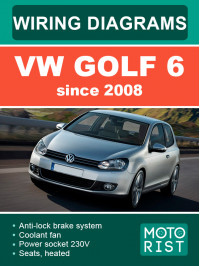


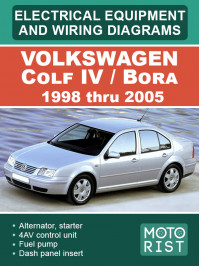

Volkswagen Golf wiring diagrams are the basis for any repair and maintenance of one of the most popular VAG models. Proper diagnostics of the electrical system directly impacts the stable operation of the engine, lighting, safety, and comfort. In modern Golfs, the electrical system has become so complex that it is impossible to accurately determine the source of a fault or correctly install additional equipment without diagrams.
The Golf model has become synonymous with reliability and technological advancement. Over decades of production, Volkswagen engineers have perfected not only the engines and transmission, but also the vehicle's electrical architecture. Today, the Golf wiring diagram is a multi-layered system combining dozens of modules, sensors, and controllers connected by a common data bus.
Volkswagen Golf Wiring Diagrams
The first Volkswagen Golf (Mk1) was released in 1974, replacing the legendary Beetle. The electrical system back then was simple: a minimum of relays, basic wiring, and a classic 12-volt circuit. With the advent of fuel-injected engines in the Golf II (1983–1992), electronic control units, fan relays, and fuses for the fuel injection and lighting systems were added.
The transition to the third generation (Golf III, 1991–1998) marked a turning point. The system incorporated ABS units, airbag systems, and an immobilizer. The fourth generation (Golf IV, 1997–2004) introduced a digital architecture, introducing CAN buses, comfort modules, electrically adjustable mirrors, and power windows.
In the Golf V and VI (2004–2012), the electrical circuits became even more complex: rain and light sensors, stability control systems, automatic climate control, and multimedia were added. Starting with the Golf VII (2012–2020), the car switched to the MQB platform, which allowed all components to be combined into a single modular structure, with each subsystem controlled by a central controller.
The modern Golf VIII (since 2020) is a digital car. Its electrical system is fully integrated with driver assistance systems, adaptive headlights, an automatic transmission, and electronic driver assistance systems.
Description of Volkswagen Golf Wiring Diagrams
The Volkswagen Golf wiring diagrams are built around a 12-volt network with a negative ground and several backbone buses: CAN, LIN, and FlexRay (in higher trim levels). The main components include the battery, alternator, starter, fuse boxes, and dozens of control modules.
Depending on the generation and engine (1.4 TSI, 1.6 TDI, 2.0 GTI, R-line, etc.), the wiring diagrams vary in the number of components and connections. Digital tools are used for diagnostics, and original Volkswagen wiring diagrams are used for understanding the system.
The electrical system is divided into subdiagrams: powertrain, engine management, safety systems, climate control, lighting, multimedia, and instrument cluster. Each diagram is provided with terminal designations, wire colors, and connector numbers.
For reliability, the Golf's wiring is protected by multi-layer insulation and undergoes vibration and corrosion testing. However, with age, problems can occur: ground faults, damaged insulation, contact oxidation, relay failure, or malfunction of the comfort control unit.
Volkswagen Golf Repair Manual
For diagnosing and repairing the electrical system of a Volkswagen Golf, we recommend using the repair manual in PDF format, which contains all the electrical diagrams and wiring diagrams. This document helps both professionals and owners quickly navigate their vehicle's electrical system.
The manual details:
- Fuses and relay locations;
- CAN and LIN bus structure;
- Contact designations and color coding;
- Electrical diagrams for the engine, headlights, sensors, and multimedia;
- Testing methods with a multimeter and oscilloscope.
This information is especially important when installing alarms, video recording systems, replacing headlights, or repairing the ABS unit. The wiring diagram allows you to understand which wire is responsible for the power supply, where the ground is located, and what signal is sent to the sensor or actuator.
Typical problems solved using the Volkswagen Golf wiring diagrams:
- The window lift or central locking does not work;
- Power to the comfort unit is lost;
- The headlights or taillights do not turn on;
- The instrument panel is flickering or the display is not lit;
- The climate control is not working;
- Airbag system error;
- The car will not start due to an immobilizer failure.
Knowing the wiring diagrams for the Volkswagen Golf saves time and money during maintenance. Even if the owner does not perform repairs themselves, understanding the electrical system structure helps better explain the problem to a specialist and avoid unnecessary problems. Avoid unnecessary part replacements.
Using original Volkswagen Golf wiring diagrams ensures accurate diagnostics, safe connection, and a long service life for all vehicle systems. For precise repairs, upgrades, and installations, these diagrams are an indispensable tool that no professional auto repair shop can do without.