


Information on repair and maintenance of engine Mitsubishi cars electronically














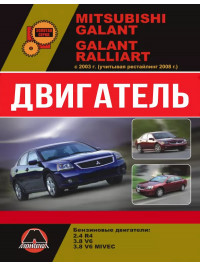

Mitsubishi engines have a long and rich history, which began more than a century ago. The first engine under the Mitsubishi brand appeared in 1917 - it was installed on the Mitsubishi Model A, which became the first Japanese mass-produced car.
History of Mitsubishi engines
Already in the 1930s, Mitsubishi began producing aircraft engines, which contributed to the accumulation of technological experience. In the post-war years, the company focused on the development of automotive power units and quickly took a strong position in the market.
In the 1960s, the Orion, Saturn and Sirius series of gasoline engines were released, and a little later the famous 4D55 and 4D56 diesel engines appeared, distinguished by their endurance and stable operation in harsh conditions.
In 1992, the company introduced MIVEC (Mitsubishi Innovative Valve timing Electronic Control) technology, which was an important step in increasing the power and efficiency of gasoline engines.
Types of Mitsubishi engines
For decades, Mitsubishi has created engines that have been installed not only on its own cars - such as Lancer, Pajero, Galant, Delica, L200 and Outlander - but also on cars of other brands, including Hyundai, Chrysler, Dodge and even Proton.
Some of the most popular gasoline engines were 4G63 and 6G72. The first became famous thanks to its turbocharged versions installed on the Lancer Evolution I–IX, and the second was widely used on business-class sedans and SUVs. The 4G93 engine has become a common solution in compact cars, providing a good balance of power and fuel economy.
Among diesel models, a special place is occupied by 4D56, 4M40 and 4M41. These engines have gained a reputation for being reliable and easy to repair units, capable of traveling hundreds of thousands of kilometers, subject to proper maintenance and the use of high-quality fuel.
Technically, Mitsubishi engines are distinguished by a variety of designs. Depending on the model, the cylinder block can be aluminum or cast iron, the timing belt can be driven by either a belt or a chain. Diesel versions are often equipped with balance shafts to reduce vibrations. The fuel injection system varies: older diesel engines use mechanical injection pumps, while newer ones use common rail systems.
Gasoline engines use injectors, ignition coils for each cylinder, knock sensors, and variable valve timing systems (MIVEC).
Many Mitsubishi engines are famous for their simple design: they can be serviced even in the field, and spare parts are available worldwide. Another important advantage is the possibility of major repairs - the piston group, cylinder head, and attachments can be restored without the need for a complete engine replacement.
Mitsubishi Engine Repair Manual
For full maintenance and repair of Mitsubishi engines, there is a detailed manual in PDF format. Such a document contains clear instructions for all stages of maintenance - from replacing the timing belt to a complete overhaul.
It is also important that the manual contains technical data for setting up the electronic control unit (ECU), including error reading procedures, throttle adaptation, and sensor calibration. Thanks to the availability of wiring diagrams and step-by-step dismantling algorithms, the master or car owner can independently eliminate faults without resorting to the help of a service station.
Using the Mitsubishi engine repair manual in PDF, you can solve the following typical problems:
- unstable engine operation at idle;
- difficult starting in cold weather;
- vibrations and noise from the cylinder block or valve cover;
- dips in traction during acceleration;
- increased fuel or oil consumption;
- the appearance of an error in the valve timing system (MIVEC);
- overheating and coolant leakage;
- jamming of the turbine or EGR malfunctions.
It contains assembly diagrams, tables tolerances and clearances, error codes, instructions for diagnosing the ignition system, fuel system, valve timing, turbocharging and valve mechanism.
The manual will be useful not only for Mitsubishi owners, but also for repair specialists who deal with engines of this brand in different cars and vehicles. A clear structure, the presence of technical diagrams and practical advice make the PDF document an indispensable tool for diagnostics and repair.