


Electrical wiring Kia Rio in electronic form


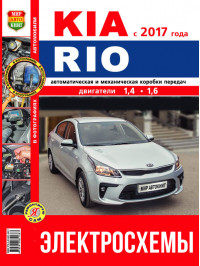




Kia Rio is one of the most popular cars of the Korean brand, having earned trust thanks to its combination of simplicity, reliability, and affordability. With each new generation, the model became more technologically advanced, and along with that, its electrical architecture became more complex. Therefore, accurate Kia Rio wiring diagrams play a key role in maintenance, diagnostics, and repair.
The Rio’s electrical system controls all vehicle functions — from turning on the headlights and power windows to operating safety systems, climate control, and multimedia. Any modern auto electrician knows: without the correct wiring diagram, it is impossible to accurately determine a malfunction. Manuals with wiring diagrams allow you to understand how control units, relays, fuses, and sensors interact with each other.
History of Kia Rio Electrical Equipment
The first generation of the Kia Rio appeared in 2000 and became the brand's first independent project in the class of compact sedans and hatchbacks. Even then, the car had a sufficiently advanced electrical system — fuel injection, electronic transmission control, and a basic comfort module.
- Kia Rio I (2000–2005) — a simple and reliable wiring system without complex CAN buses. The electronics included only basic systems: ECU, alternator, starter, ABS, and lighting.
- Rio II (2005–2011) — introduced CAN bus, BCM block, and an electronic throttle. Wiring diagrams became significantly more complex, additional sensors appeared, and automatic climate control was added.
- Rio III (2011–2017) — a completely new architecture, digital control units, ESP module, and modern multimedia system.
- Rio IV (2017–2023) — an upgraded electrical system with extensive use of Bosch and Hyundai Mobis modules. New features appeared: Auto Hold, Smart Key, rear-view camera, tire pressure monitoring system.
- Rio V (from 2023) — the latest generation on the GB platform with a digital instrument cluster and integration with Kia Connect telematics.
Each generation had its own wiring diagrams tailored for engines 1.2, 1.4, 1.6 MPI, and 1.6 GDI, as well as MT and AT transmissions.
Characteristics of Kia Rio Electrical Equipment
The Kia Rio electrical system is a clearly structured network with main control units connected via a CAN bus. This system ensures stable operation of all subsystems and simplifies diagnostics.
A typical wiring diagram includes:
- ECU (Engine Control Unit) — engine control module responsible for fuel injection, ignition, and mixture regulation;
- BCM (Body Control Module) — controls lighting, central locking, alarm system, and power windows;
- ABS/ESP module — responsible for braking and stability control;
- TCU (Transmission Control Unit) — automatic transmission control unit;
- ACU (Airbag Control Unit) — controls airbag deployment systems;
- PCM (Powertrain Control Module) - integrates engine and transmission control functions;
- IMMO (Immobilizer System) - anti-theft system, manages the chip key.
Each vehicle version includes individual diagrams for fuse and relay locations, as well as wiring routes throughout the body - in the doors, sill area, trunk, and dashboard.
Guide to Repairing Kia Rio Electrical Equipment
Official Kia Rio repair manuals in PDF format include detailed wiring diagrams, connectors, pin numbers, and wire color codes. They are indispensable for diagnosing and fixing any electrical malfunctions.
Using these diagrams, you can:
- determine power and ground circuits for each unit;
- locate breaks or short circuits in wiring harnesses;
- correctly install additional equipment (alarm system, camera, parking sensors);
- replace BCM or ECU without connection errors;
- measure resistance and voltage at critical points.
The manuals are divided into sections - engine, body, safety systems, climate control, lighting, multimedia, and ABS. Each diagram includes pin numbering and layout in the wiring harness, which greatly simplifies the repair process.
The Kia Rio wiring manual describes solutions to the following issues:
- Headlights or DRLs not working due to a break in the harness;
- CAN bus error between ECU and ABS;
- Issues with heater and blower operation;
- Blown fuses in the lighting circuit;
- Failure of power windows or central locking;
- Brake pedal position sensor errors;
- Malfunctions in the immobilizer or chip key.
Wiring diagrams are essential for understanding the structure of any Kia Rio. They are needed not only for repairs but also for installing additional equipment - multimedia systems, alarms, seat heating, or parking sensors. Even in the latest versions with multi-level electronic architecture, accurate diagrams help prevent malfunctions in the onboard network.
Kia Rio remains one of the most service-friendly cars in its class. Its electrical system is logically designed, and the availability of manuals and diagrams makes maintenance easy even for beginner mechanics. This is why the Rio is so often chosen for taxi services and daily driving - it is simple, economical, and easy to repair.