Information on repair and maintenance of engine BMW cars electronically








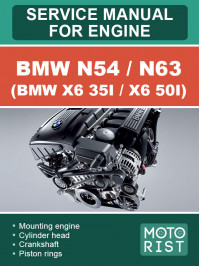
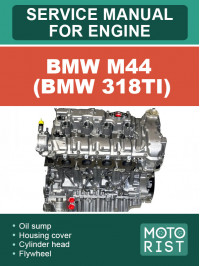
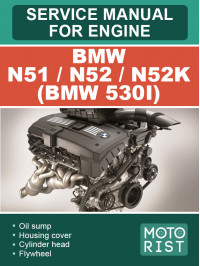
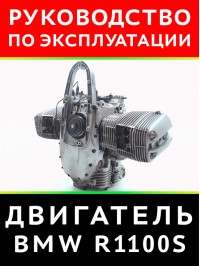
The history of BMW engines begins with aviation: in 1917, Rapp Motorenwerke transformed into Bayerische Motoren Werke and began producing engines for aircraft.
It was the aviation past that formed the main principle of BMW - high specific power with minimal weight. Already in the 1930s, the company mastered the production of car engines, including in-line six-cylinder engines, which became the hallmark of the brand.
History of BMW engines
After World War II, BMW began an active recovery and already in the 1960s created the M10 line - four-cylinder engines that laid the foundation for future success in motorsports. The M10 was used as the basis for the turbocharged engine for Formula 1, which in 1983 brought Nelson Piquet to the championship. In the 1970s, BMW introduced the six-cylinder M30 series, the "big six", which was used until the end of the 1990s.
An important stage was the appearance of the M50 line in the 1990s, already with electronic control, VANOS phase shifters and multi-point injection. Later, the M54 series appeared, then the N-family, and today the B-series of engines are relevant, including turbocharged B38, B48, B58 and diesel B47, B57. To this day, BMW remains one of the few brands that consistently develops in-line six-cylinder engines, including for the M sports models.
BMW engine specifications
BMW consistently introduced technological innovations such as aluminum cylinder blocks, double VANOS, Valvetronic, direct injection and TwinScroll turbocharging. An important difference is the focus on smooth traction, responsiveness and "mechanical character" in any conditions.
The most famous BMW engines by generation:
- M10 - in-line "four" 1.5-2.0 liters, produced from 1961 to 1988, became the basis for the F1 turbo engine.
- M30 - naturally aspirated six-cylinder engine with a volume of up to 3.5 liters, 1968-1992, reliable and legendary.
- M50 / M52 / M54 - DOHC engines with VANOS, were distinguished by high traction and a service life of up to 500 thousand km.
- N52 / N53 / N54 / N55 — generations with Valvetronic, TwinTurbo, direct injection.
- B-series (B38, B48, B58) — a modern modular line from 1.5 to 3.0 liters, used since 2015.
- S-engines (S50, S54, S55, S58) — sports units for M models, producing up to 510 hp.
- V8 (N62, N63) and V12 (N73, N74) — used in 7 Series and Alpina, focused on maximum comfort.
- Diesel M47, M57, N47, B47, B57 — are distinguished by their economy and high torque.
The B58 deserves special attention - a six-cylinder turbo engine, recognized as one of the best in the world in terms of reliability and tuning potential. It is installed in the BMW 540i, Toyota Supra and other powerful models. In the version with MHEV technology (mild hybrid), a 48-volt electrical system is additionally used.
BMW inline "sixes" are distinguished by ideal balancing, which makes them incredibly smooth in operation. Platform unification allows the use of the same solutions on different models, facilitating maintenance and finding spare parts.
The latest generation turbo engines have liquid intercooler cooling, an electronically controlled thermostat, built-in manifolds in the cylinder head and combined oil pumps.
However, there are also vulnerabilities. For example, N20/N26 engines are known for timing chain guide failure, and early N47s have rapid chain wear. N54 is technically excellent, but prone to carbon deposits, turbo leaks, and HPFP fuel system failure. Modern B-series are free of most of these problems, but require high-quality fuel and oil.
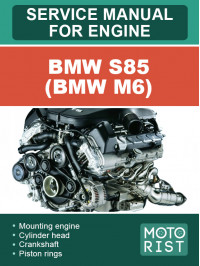
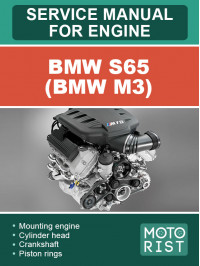
BMW Engine Repair Manuals
There are detailed PDF repair manuals for all generations of BMW engines. These documents are indispensable for diagnosing complex systems and performing work without errors.
Typical content of the PDF manual includes:
- factory specifications, tolerances, tightening torques;
- step-by-step procedures for removing / installing the engine;
- checking the timing phases and adjusting VANOS / Valvetronic;
- instructions for adapting DME units and resetting errors;
- wiring diagrams for turbocharging, EGR system and fuel injectors;
- procedures for eliminating oil leaks, diagnosing fuel pressure;
- decoding of OBD-II error codes and instructions for resetting service intervals.
PDF manuals are presented in both English and Russian. This simplifies the maintenance of BMW models in the post-Soviet space, where even complex work, such as replacing Valvetronic clutches, has become possible without going to the dealer.
Thus, BMW engines are not just motors, but engineering works of art that combine precision, power and a high level of intellectual control. With a PDF manual, each of them becomes accessible for understanding, diagnostics and competent maintenance.